PRACTICAL CATAMARAN GUIDE
THE SHORT ANSWER
For nine or ten guests, compare the exact cabin plan—not just the advertised berth count. Confirm who will share double beds, whether anyone would use a saloon or forepeak, and where the skipper or crew will sleep.

A convertible saloon may add berths, but it also changes how the group can use its main shared living space.
These terms describe different aspects of a yacht’s capacity. The distinction matters because a yacht can have enough listed berths without giving every guest a suitable bedroom.
Cabin
An enclosed sleeping compartment. It might contain a double bed, two bunks or another arrangement.
Berth
One sleeping position. A double bed may count as two berths even though it is in one cabin and requires two people to share.
Comfortable accommodation
A practical judgment that considers privacy, bed access, storage, ventilation, bathroom use and the needs of the actual group.
A yacht with four double cabins may provide eight cabin berths. If its saloon converts into a double bed, the listing may show ten berths. That is not equivalent to a five-cabin yacht for guests who want private cabins or separate beds.
The total berth count is a useful starting point, but it does not explain where everyone sleeps. Ask for the cabin plan and a written explanation of every sleeping position before treating the advertised capacity as suitable.
• Five guest cabins for two people each.
• Four double cabins plus two saloon berths.
• Four double cabins plus a bunk cabin.
• Four guest cabins plus one or two small forepeak berths.
• A combination of permanent beds and convertible sleeping spaces.
Also distinguish between the yacht’s maximum permitted capacity and the number of people it accommodates comfortably for a full week.
The same headline capacity can produce very different arrangements. Match each space to the people who would actually use it.
Double cabins
A double cabin works naturally for a couple, but may not suit friends, teenagers or relatives who do not want to share. Check the bed’s shape, access from each side, headroom, storage, ventilation and bathroom arrangement.
Bunk cabins
Two single berths can be useful for children, teenagers or friends who prefer separate beds. Confirm berth dimensions, ventilation, storage and whether the upper bunk suits its intended occupant.
Convertible saloons
A saloon bed offers flexibility but little privacy. It may need to be assembled every evening, cleared every morning and can reduce access to the yacht’s main indoor shared space.
Forepeak accommodation
Forepeaks are compact compartments at the forward ends of the hulls. Some are fitted for crew; others are storage spaces. Confirm safe access, ventilation, mattress, bathroom access and approved use.
A group may fit the published guest capacity until a skipper or another crew member is added. Professional crew need appropriate sleeping arrangements.
On some yachts the skipper can use a dedicated forepeak berth. On others, the skipper needs one of the main cabins. A hostess, cook or second crew member creates another accommodation requirement.
For example, five guest cabins may appear sufficient for ten guests. If the skipper must occupy one of those cabins, only four remain for the group. The alternatives may be to use a suitable crew berth, accept a saloon arrangement, reduce the guest count or choose another yacht.
Ask the operator to confirm in writing
• where each professional crew member will sleep;
• whether any crew accommodation is separate from guest cabins;
• whether the proposed crew berth is approved and suitable;
• which guest spaces remain after crew allocation;
• whether local rules or operator policy limit the final number aboard.
Two catamarans of similar length—or even two versions of the same model—can have different accommodation plans. One may have four larger guest cabins, while another divides the space into more, smaller cabins.
An owner’s version may dedicate much of one hull to a large suite, while a charter version may provide additional guest cabins. Crew compartments, bathroom arrangements and saloon conversions can also differ. Equipment and refits may vary between individual yachts.
Review the exact yacht being offered rather than relying on a generic model description.
• Current cabin plan and recent photographs.
• Permanent and convertible berths.
• Guest and crew allocation.
• Bathroom arrangement.
• Operator-stated overnight capacity.
• Equipment list, charter contract and obligatory extras.
Five-cabin catamarans: useful examples, not guarantees
For nine or ten guests, five genuinely usable guest cabins are normally the cleanest starting point. The important word is usable: manufacturer options, charter conversions and crew berths can change what the cabin count means.

Lagoon 50: check the version, not only the name
Lagoon currently publishes 3-, 4- and 6-cabin versions of the Lagoon 50. A charter listing may also count forepeaks or crew spaces separately, so request the exact lower-deck plan for the yacht offered. Image: Lagoon, official six-cabin layout.
Bali 4.8: a documented five-cabin option
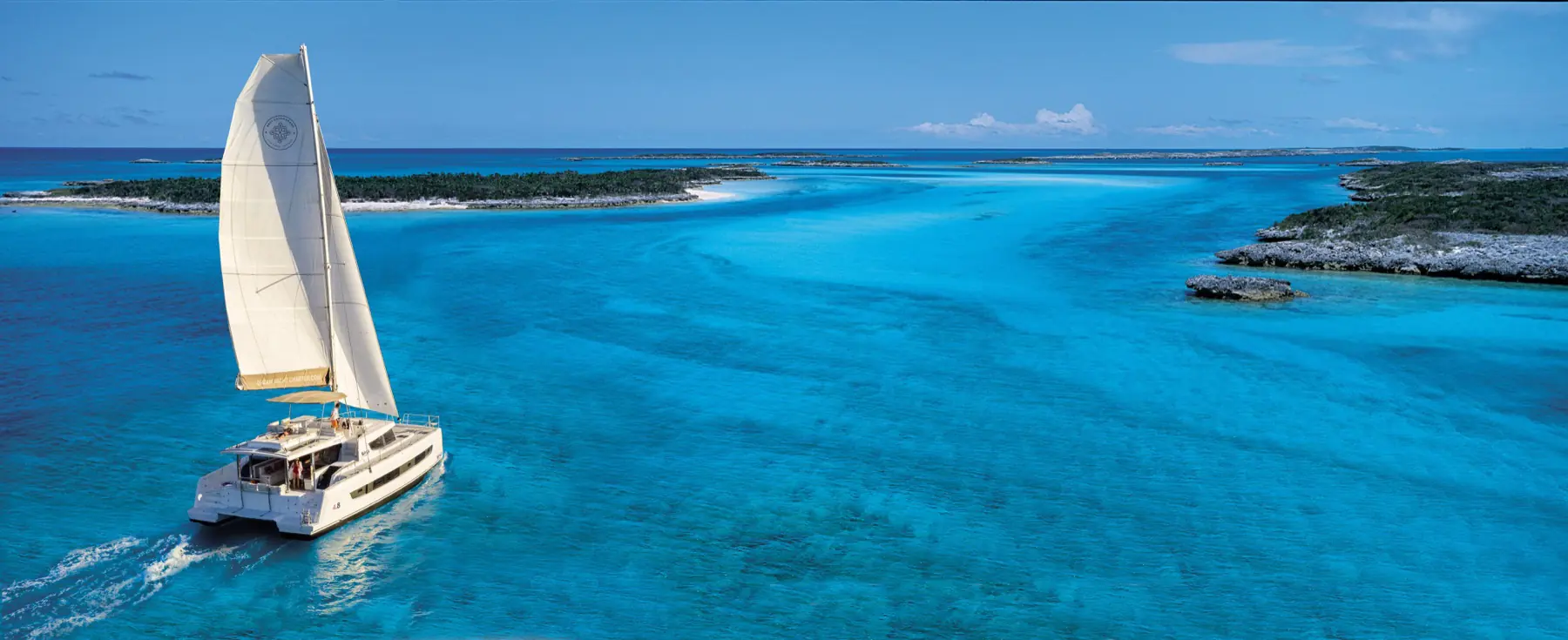
Bali documents a five-cabin version with four double cabins and one twin cabin, as well as other configurations. That can suit nine or ten guests when the twin arrangement fits the group and crew berths remain available. Photo: Bali Catamarans.

Five guest cabins are a starting point
For five couples or five family units, begin with five usable guest cabins. Models such as the Saona 47, Lagoon 50 and Bali 4.8 appear in large-group searches, but the specific yacht’s beds, heads and crew accommodation still decide whether it works. Photo: Lagoon.
Configuration note: manufacturer images illustrate factory versions. Before booking, Seeksail checks the layout and stated capacity of the specific charter yacht offered.
These examples show how different groups might approach the same headline capacity. They are illustrations, not guarantees that a particular yacht or operator will permit the arrangement.
Five couples
Five double guest cabins may work efficiently.
Main point to confirm: Confirm that a hired skipper has separate approved accommodation.
Four couples and two children
Four double cabins plus a bunk cabin may suit the group.
Main point to confirm: Confirm that the bunk cabin is suitable for the children.
Three couples and four friends
Three double cabins plus four permanent single berths may work.
Main point to confirm: Confirm that the single berths are in proper guest accommodation.
Four couples and one additional adult
Four double cabins plus one permanent single berth may work.
Main point to confirm: Confirm that the ninth berth provides acceptable privacy and comfort.
Four couples and two additional adults
Four double cabins plus a convertible saloon may fit the numbers.
Main point to confirm: Confirm that both adults knowingly accept sleeping in the shared saloon.
Ten guests with a skipper and hostess
The yacht needs ten suitable guest berths plus two appropriate crew berths.
Main point to confirm: Confirm that both crew positions exist without reducing guest accommodation.
A layout that works for families with children may not work for ten adults. A group of five couples may use double cabins efficiently, while a mixed group may need more separate beds.
Prepare a rooming list before requesting quotes. For each person, record whether they can share a double bed, use a bunk, sleep in a compact cabin or accept a convertible saloon.
Group arrangements
• How many adults and children are travelling?
• Which guests are couples, and who needs a separate bed?
• Does anyone need a private cabin or have mobility, access or ventilation requirements?
• Would anyone genuinely accept a bunk or saloon bed?
Yacht layout
• How many enclosed guest cabins are there?
• Which cabins have double, twin or bunk beds?
• Which berths are permanent and which require a saloon conversion?
• Is the published layout for the exact yacht rather than another version?
Skipper and crew
• Is a skipper required or being hired?
• Will there also be a hostess, cook or other crew member?
• Where will each crew member sleep?
• Will professional crew use any guest cabin?
Booking confirmation
• What is the yacht’s permitted overnight capacity?
• Does the operator approve the proposed rooming arrangement?
• Are linen and towels supplied for every approved berth?
• Does the contract match the agreed guest and crew numbers?
For nine or ten guests, begin with people rather than specifications. List who will share, who needs a separate bed and where any professional crew will sleep.
Then compare only yachts whose exact layouts support that plan without relying on uncomfortable assumptions.
Seeksail advisers review charter requests and help customers identify suitable yachts, understand accommodation compromises and confirm important details with the operator.
A SHORTLIST BUILT AROUND YOUR GROUP
A Seeksail adviser will review your request and help you find suitable yachts. We will normally reply within one business day.
Request My Yacht Shortlist