
What the advertised price leaves out
The advertised charter fee is only one part of the cost of a Croatia catamaran charter. Your realistic budget may also include a mandatory charter pack, tourist tax, fuel, marina or mooring fees, provisioning, transfers, a skipper or crew, and either a security deposit or damage-waiver arrangement.
There is no responsible single percentage to add to every yacht. Inclusions and charging methods vary by operator, base, yacht and booking. The safest comparison is a line-by-line estimate for the exact yacht and week.
Start with the base charter fee
The base fee normally covers use of the yacht for the contracted period, but it does not tell you everything included onboard. Linen, towels, dinghy, outboard engine, final cleaning, Wi-Fi or safety equipment may be included, packaged into a mandatory local charge, or priced separately.
Ask for an inclusion list rather than relying on a label such as “fully equipped.” It should show what is supplied, how many sets are included and whether anything is payable at the base.
Obligatory extras
Operators often collect a mandatory local package under names such as charter pack, comfort pack, transit log or service pack. Its contents differ. It might cover final cleaning, bed linen, towels, gas, administration or the outboard engine, but the name alone is not enough to understand it.
There may also be a Croatian tourist tax or other locally required charges. Ask whether these are included in the quote, calculated per person, or paid separately at check-in.
For a useful comparison, request one list headed “mandatory and non-refundable.” That prevents obligatory costs from becoming mixed with optional upgrades.
Security deposit and damage waiver
For a modern 40–50 ft catamaran in Croatia, a full refundable security deposit commonly falls around €3,000–€5,000. Current 2026 Lagoon 46 examples reviewed by Seeksail sit within this range. The amount is normally reserved or charged at check-in rather than spent automatically, and the exact figure belongs to the specific yacht and contract.
A deposit-reduction or damage-waiver package is not the same everywhere. One current 2026 scheme for 44–47 ft yachts combines a €400 non-refundable fee with an €800 refundable deposit; other products reduce the deposit further or remove it, but may exclude the dinghy, outboard, blocked toilets, fuel errors, late return, gross negligence or unreported damage. Independent deposit insurance is another option: Pantaenius says its cover can protect against full or partial retention of an insured deposit, subject to its policy terms and eligibility.
Deposit insurance reference: Pantaenius charter deposit insurance →
Questions to ask about the deposit or waiver
Ask for the full deposit; how it will be authorised and released; the non-refundable waiver fee; the reduced deposit that remains; whether cover resets after each incident; exclusions for sails, dinghy, outboard, toilets and lost equipment; the reporting procedure after damage; and whether hiring the operator’s skipper changes any liability.
Skipper and additional crew
For planning, current 2026 Croatian price lists reviewed by Seeksail show approximately €220 per day for a catamaran skipper up to 45 ft, €240 per day for a Lagoon 46 and €250 per day for a Lagoon 50; another current list uses €200 per day across its fleet. For seven charged days, allow roughly €1,400–€1,750 before food. Confirm whether every calendar day, including handover and return, is charged.
The skipper’s food is normally excluded. The skipper can share the group’s provisions and restaurant meals, or the group can pay an agreed allowance for meals taken separately. Current Croatian operator terms reviewed by Seeksail use at least €30 per crew member per day; some separate-board arrangements use €40 per day. Agree this before arrival. The skipper also needs a suitable berth—often a dedicated cabin or approved forepeak—and access to a bathroom.
Additional crew changes the budget and the accommodation plan. In current 2026 Croatian examples, a hostess is approximately €180–€210 per day and a cook approximately €200–€260 per day, plus food. A hostess usually prepares breakfast or a light lunch and handles light housekeeping; do not assume that the role includes a full dinner service. Put duties, hours, cabin use and meal arrangements in writing.
Gratuity is discretionary. For a skipper hired separately with a bareboat, a practical local planning figure is about 5–10% of the skipper’s fee for good service—not a compulsory charge. This should not be confused with MYBA’s broader 5–15% of gross charter fee guideline for fully crewed yachts. Ask which convention fits the actual contract and hand any tip directly at the end of the charter.
Gratuity reference: MYBA crew gratuity guidelines →
Fuel
Fuel cannot be estimated responsibly from yacht length alone. Ask the operator for the expected litres per hour for the exact engines and for the generator, if fitted. Build the estimate as engine hours × combined engine consumption × price per litre, then add generator hours × generator consumption × price per litre. Keep motoring and generator use as separate assumptions so air-conditioning does not disappear inside a vague fuel allowance.
For a changing public benchmark, the European Commission’s Weekly Oil Bulletin publishes regularly updated Croatian diesel consumer prices. It is a national road-fuel reference—not a promise of the price at a marina pump—so record the actual marina or operator price when booking and check it again before departure. Confirm how the handover fuel level is measured and where the yacht must be refilled before return.
Current fuel reference: European Commission Weekly Oil Bulletin →
Marinas, town quays and moorings
Overnight costs can vary substantially by location, yacht dimensions, season and berth type. Catamarans may be charged differently because of their beam. An itinerary that uses marinas every night will have a different budget from one that uses a mixture of anchorages, buoys and town quays.
The right question is not “Are moorings included?” but “Which overnight stops are realistic for our route, and which of them are likely to charge separately?” No adviser can guarantee every berth in advance unless it has actually been reserved and confirmed.
Food, drinks and provisioning
Self-provisioning gives the group control over spending, but it still involves transport, shopping time and storage planning. Pre-ordered provisioning can be convenient but may carry delivery or service charges. If you hire crew, clarify who provides their meals and whether the group expects to eat aboard or ashore.
Build a food budget around your group’s habits, not a generic daily figure. A group cooking breakfast and lunch aboard with occasional dinners ashore will spend differently from one using restaurants most evenings.
Transfers and optional equipment
Airport transfers, early boarding, Wi-Fi packages, stand-up paddleboards, safety nets, extra linen and other equipment may be optional. Some are valuable for a particular group; others are easy to add without improving the trip.
Separate them into three columns:
1. essential for this group; 2. useful if the budget permits; 3. unnecessary.
For example, a safety net may be important to a family with young children, while early boarding may have little value if the group’s flight arrives in the evening.
A realistic Lagoon 46 planning example
Example only, not a quotation: published 2026 Croatian operator lists reviewed by Seeksail price individual Lagoon 46 yachts from about €4,400–€4,580 in the lowest periods to approximately €13,300–€14,000 in peak weeks, before discounts and extras. Two yachts of the same model can still have different age, equipment, maintenance history, base costs and commercial terms.
For one illustrative peak-week calculation, begin with €13,300 charter fee, €460 charter pack, €1,680 skipper fee (7 × €240), €210 minimum separate-meal allowance (7 × €30) if the skipper does not share the group’s meals, and €644 for two dated ACI marina examples (€308 at Milna plus €336 at Palmižana). The resulting €16,294 subtotal still excludes tourist tax, every other berth or buoy, fuel, guest provisions, transfers, optional equipment, gratuity and any non-refundable waiver fee.
Show the refundable deposit separately from expected spending. If the group buys a waiver, add the non-refundable fee and show the reduced deposit that remains. If the skipper eats with the group, remove the separate food allowance but provision for one additional adult. This is the difference between a useful budget and a headline yacht price.
Worked example: a 14-metre catamaran in July or August
The figures below are examples from the official ACI tariff PDF currently linked from ACI Marinas. The document is the 2025 price list and was checked on 7 September 2026. It is useful for understanding how the calculation works, but it is not a quote for a future stay. Always enter the exact yacht dimensions and date in ACI’s current booking tool before reserving.
Marina-price reference: Official ACI price list (PDF) →
Published ACI examples for a yacht up to 14 metres
ACI Marina Milna: the July–August table shows €154 for a daily wet berth. The same tariff states that a catamaran or trimaran on a daily wet berth receives a 100% uplift from 1 June to 30 September, producing a dated example of €308.
ACI Marina Palmižana: the July–August table shows €168. Its tariff applies a 100% daily-berth uplift to multihulls from 1 June to 30 September, producing a dated example of €336.
ACI Marina Žut: the July–August table shows €138. Its tariff applies a 50% multihull uplift during July and August, producing a dated example of €207.
ACI Marina Piškera: the July–August table shows €162. With the stated 50% multihull uplift, the dated example is €243. The tariff also says the Kornati National Park entrance ticket is included in the regular Piškera daily-berth price.
ACI Marina Split illustrates why the final calculation must be checked carefully: its July–August base table shows €194 for up to 14 metres, the tariff applies a 100% multihull uplift, and Friday, Saturday and Sunday prices are 10% higher. Use the official calculator rather than copying one component of the tariff.
ACI’s general price list says prices are in euros and include 25% VAT, while services outside the main price list may be charged under each marina’s internal tariff. This is why the yacht’s length, beam, date, marina and optional services all belong in the same comparison.
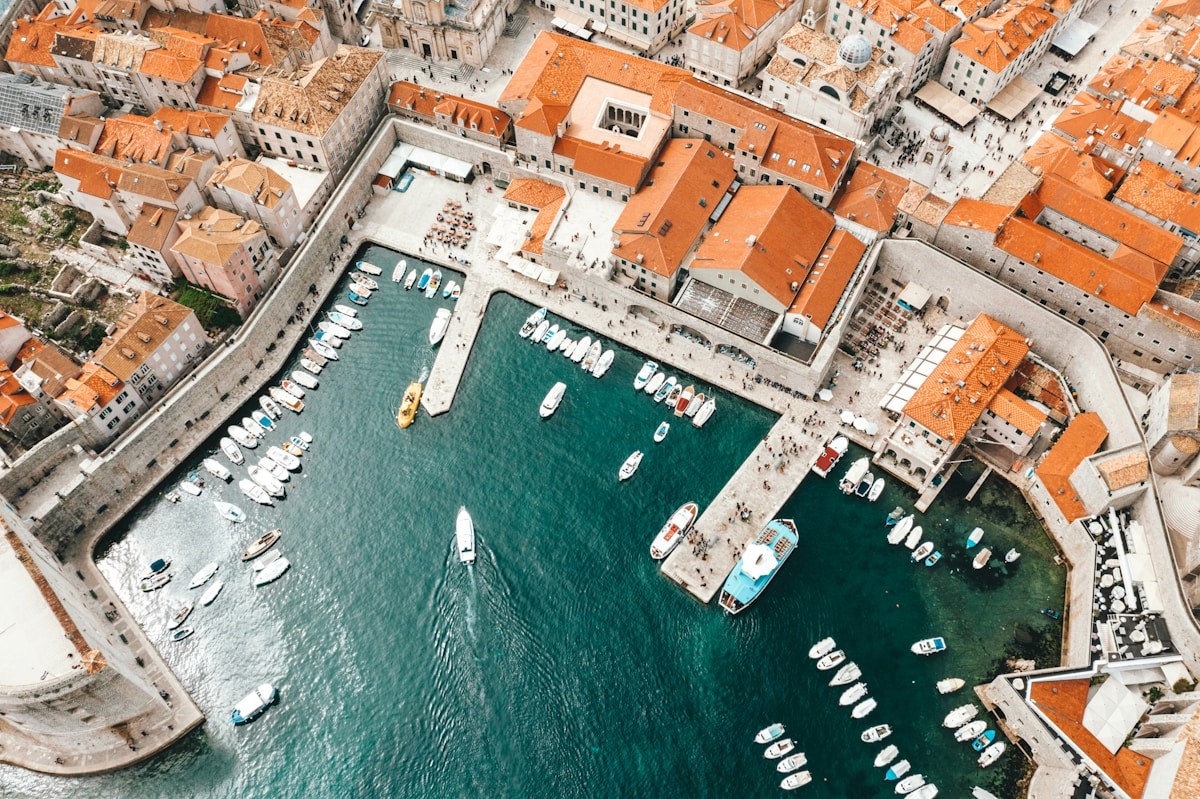
Actual marina names to use in a Croatia budget
Split and Trogir area: ACI Marina Trogir, Marina Baotić at Seget Donji, ACI Marina Split, ACI Marina Milna on Brač, ACI Marina Vrboska on Hvar and ACI Marina Palmižana on the Pakleni Islands.
Šibenik, Kornati and Krka area: D-Marin Mandalina in Šibenik, ACI Marina Vodice, ACI Marina Jezera, Marina Hramina at Murter, ACI Marina Žut, ACI Marina Piškera and ACI Marina Skradin.
Zadar and northern Dalmatia: D-Marin Dalmacija at Sukošan, D-Marin Borik in Zadar, Marina Kornati at Biograd, ACI Marina Šimuni on Pag and ACI Marina Žut when the route turns south toward Kornati.
Dubrovnik and southern Dalmatia: ACI Marina Dubrovnik, Marina Frapa Dubrovnik, ACI Marina Veljko Barbieri at Slano and ACI Marina Korčula. These are not interchangeable: airport transfer, first-day sailing time and the planned islands may make one base much more sensible than another.
Marina, town quay, buoy or anchorage?
A full-service marina provides the clearest published tariff, but it is not the only overnight option. Town quays are usually convenient for restaurants and supplies. Concessioned buoy fields and restaurant moorings follow their own terms. A suitable anchorage may avoid a berth charge, but only where anchoring is permitted and prudent.
Croatia’s government guidance explains that anchoring may be charged at concessioned anchorages or within public ports, while an anchorage that is neither concessioned nor part of a public port may not charge an anchoring fee. Protected areas, marked restrictions and local safety rules still apply.
Anchoring reference: Croatian government nautical guidance →

An illustrative one-week cost worksheet
Example only: eight guests compare a 14-metre bareboat catamaran for one July week from the Split region. They should record the live yacht quote and mandatory pack first, then the current tourist tax, deposit or waiver, route-dependent fuel and the cost of transfers and provisioning.
For the overnight plan, they might insert the dated ACI examples of €308 at Milna and €336 at Palmižana, then obtain current prices for every other intended marina, quay or buoy. Nights at anchor should still carry a contingency because weather or space may force a paid alternative.
The worksheet should not produce a false fixed total. Its purpose is to expose the assumptions: which nights are paid, whether the catamaran uplift has been applied, what happens if the route changes and which amounts remain refundable.
Before reserving a berth
ACI’s 2026 online-booking guidance says payment authorization alone is not confirmation; a booking reference must be issued. It also states that the booked berth is normally held until 8 p.m., the marina should be contacted on VHF channel 17 no later than 30 minutes before arrival, and cancellation before 2 p.m. on the day before arrival normally returns 80% of the amount paid. Recheck the applicable terms when booking.
Berth-booking reference: Official ACI booking guidance →
Questions to resolve before paying a deposit
• What exactly is included in the charter fee?
- Which extras are mandatory, and are they already in the quote?
- What is payable in advance and what is payable locally?
- What deposit or waiver applies, and what are the exclusions?
- Does the skipper or crew need a guest cabin?
- Are fuel, marina fees and tourist tax excluded?
- Which optional items are appropriate for our group?
- Is the quote for the same dates, base, yacht version and cancellation terms as the alternative?